


How do professional bars make clear ice?
In the high-end mixology circuit, the caliber of a cocktail is judged not only by its fluid components, but also by the structure and clarity of its ice. When an artisan bar manager serves a premium pour of single-malt scotch or a meticulously balanced Old Fashioned, standard cloudy freezer cubes are completely out of place. Cloudiness signifies trapped oxygen, mineral clusters, and microscopic micro-fissures. This structural instability causes the ice to melt rapidly, over-diluting complex spirits and ruining the drinking experience. Understanding exactly how professional bars make clear ice reveals that this visual achievement relies on strict thermodynamic controls rather than mere aesthetic preference.

From our experience at Orifuture, introducing pure, glass-like geometry to a beverage program changes the perception of luxury and improves serving margins. Standard domestic ice trays freeze water from all directions simultaneously, trapping minerals and gases in the center core. To bypass this mechanical flaw, premium commercial bars manage freezing vectors to push impurities completely out of the final serving piece. This comprehensive guide outlines the thermodynamics, equipment lines, and precise processes required to master crystal-clear freezing for professional venues and home enthusiasts alike.
Table of Contents
- 1. The Thermodynamics of Directional Freezing
- 2. Commercial Production Methods in Elite Establishments
- 3. Ice Production Methods Summary Comparison Table
- 4. The Critical Processes of Tempering, Cutting, and Shaping
- 5. Fluid Engineering: How Clarity Influences Melting and Dilution
- 6. Precision Freezing for Sophisticated Bars: The Orifuture Standard
- 7. Frequently Asked Questions (FAQs)
- 8. Metrology and Thermodynamic References
1. The Thermodynamics of Directional Freezing
To accurately understand how professional bars make clear ice, you must analyze the molecular behavior of water as it shifts from a liquid to a crystalline solid. Natural bodies of water, such as lakes and ponds, freeze from the top down because ambient cold air interacts only with the upper surface layer. This linear trajectory allows dissolved gasses, micro-sediments, and mineral salts to be pushed downward into the liquid layer below, leaving behind a perfectly transparent sheet of surface ice.
Standard home ice trays freeze from all six sides simultaneously, forming an outer shell of ice that forces gases and minerals into the center, where they become trapped as cloudy, fragile pockets. We recommend utilizing insulated barriers to isolate specific freezing directions. By insulating the bottom and sides of a water volume while exposing only the top layer to cold temperatures, you force the ice to freeze in a single direction, ensuring impurities are completely separated from the final block.
2. Commercial Production Methods in Elite Establishments
High-volume cocktail bars use sophisticated commercial equipment to fulfill daily demand for pristine freezing architectures. These industrial setups manipulate thermodynamics using two primary mechanical designs.
The Clinebell Block Machine System
The Clinebell machine represents the gold standard for producing industrial-scale clear ice. This heavy apparatus houses massive insulated chambers filled with hundreds of pounds of water. It utilizes cold plates located at the bottom of the tank to drive freezing upward from the base.
Simultaneously, internal circulation pumps keep the top water layer in constant motion. This continuous agitation prevents dissolved oxygen and mineral salts from settling onto the freezing line. Once the process is complete after several days, operators lift out a pristine, 300-pound slab of crystal-clear ice. The top layer containing the concentrated impurities is then shaved away before the block is cut down for bar service.
Advanced Commercial Evaporator Lug Units
For high-turnover bars that require continuous cube production without the space or labor needed for full block carving, advanced evaporator ice cubers offer an efficient alternative. These machines spray water upward against an inverted, super-chilled copper grid layout.
Because pure water molecules freeze instantly at 0 degrees Celsius while mineral-heavy water drops require lower temperatures, the pure water accumulates on the cold grid plates while the mineral runoff drops down into a waste collector drainage system. This continuous spray filtration produces distinct individual cubes featuring absolute geometric clarity and a minimal mineral footprint, making them highly effective for busy commercial applications.
3. Ice Production Methods Summary Comparison Table
To assist beverage directors, procurement managers, and hospitality designers in reviewing freezing techniques, the following responsive table compares standard and professional methods.
| Freezing Method | Structural Integrity Index | Average Production Cycle | Primary Operational Advantage | Labor and Equipment Overhead |
|---|---|---|---|---|
| Standard Home Trays | Poor; high internal cloudiness & gases | 2 - 4 Hours | Fast turnaround; very low entry cost | None; high fracture rates under thermal shock |
| Clinebell Block Machine | Maximum; 100% crystal-clear density | 48 - 72 Hours | Massive slabs ideal for custom carving layouts | High initial cost; requires heavy manual cutting tools |
| Commercial Inverted Cuber | High; uniform clarity across all units | 20 - 30 Minutes | Continuous automated supply for high-turnover wells | Medium maintenance overhead; requires strict water filtration |
| Directional Tumbler Molds | Maximum; crystal-clear professional grade | 16 - 24 Hours | Compact, space-saving footprint for home and bars | Low; manual filling with simple tap-water setups |
4. The Critical Processes of Tempering, Cutting, and Shaping
Pulling a clear block from an insulated freezer is only half the battle. If a mixologist uses an electric band saw or a heavy ice pick on a block straight out of a sub-zero freezer, the sudden temperature shock will shatter the block into unusable pieces. This internal stress must be managed carefully through a process called tempering.
From our experience, bars must allow clear ice to sit at room temperature until its exterior becomes slick, wet, and perfectly glossy. This tempering phase realigns internal crystalline boundaries, rendering the ice pliable and safe from thermal fracturing. Once tempered, bar teams can use heavy Japanese ice saws, multi-pronged chisels, or heated aluminum presses to sculpt the ice into spheres or custom cubes without risking structural splits.
5. Fluid Engineering: How Clarity Influences Melting and Dilution
The operational reason why professional bars make clear ice centers on the fluid mechanics of dilution control. Cloudy ice contains thousands of microscopic air bubbles trapped inside the core. These bubbles act as structural stress points and exponentially increase the active surface area of the ice cube exposed to the surrounding liquid.
When warm alcohol hits these aerated pockets, the ice melts unevenly and rapidly, watering down the cocktail's flavor profile within minutes. Crystal-clear ice, by contrast, functions as a solid, high-density crystal structure that transfers thermal energy slowly and uniformly across its outer surface. This slowed melting rate allows bartenders to chill a beverage to its optimal serving temperature while preserving its intended flavor balance across prolonged sipping windows.
6. Precision Freezing for Sophisticated Bars: The Orifuture Standard

While understanding industrial manufacturing steps is valuable for menu planning, bringing crystal-clear ice production into home entertaining or compact boutique bar spaces requires smart, space-saving engineering. Orifuture develops high-performance beverage accessories and smart clear ice makers designed to deliver outstanding reliability, exceptional thermal insulation, and pristine output quality. By utilizing optimized directional freezing enclosures, our systems allow hosts to upgrade their cocktail presentations with factory-grade efficiency.
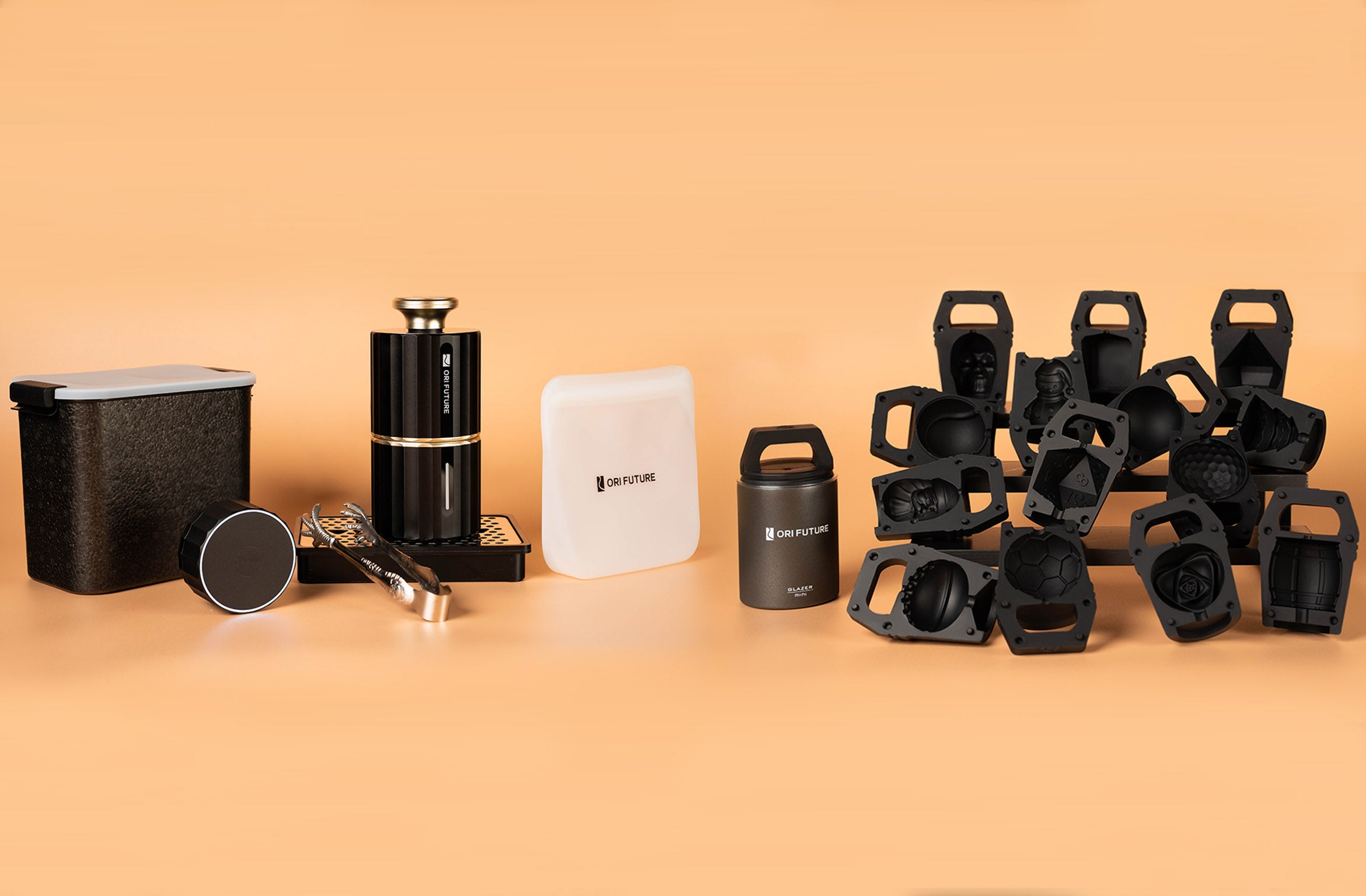
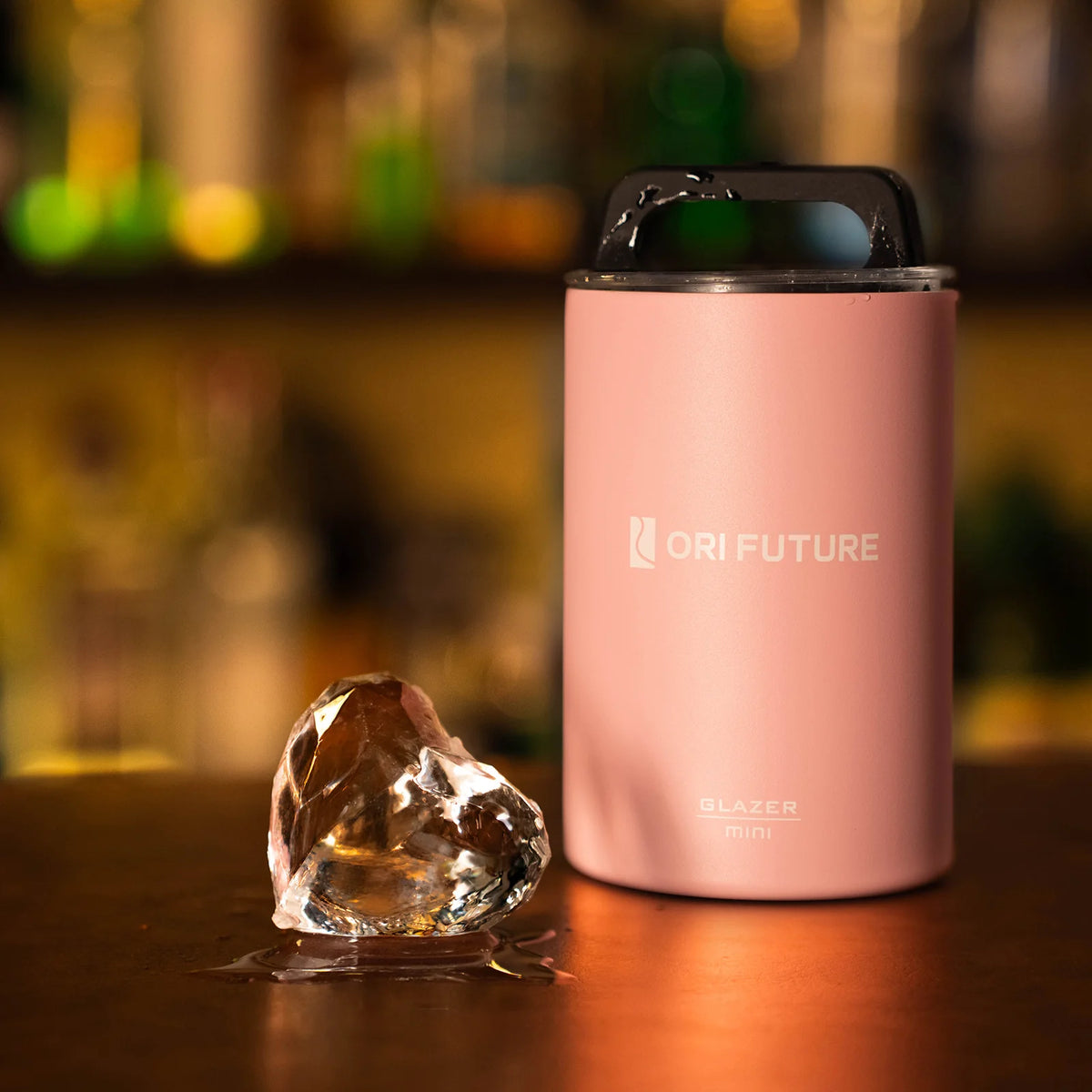
The GLAZER mini Classic Ice maker provides an exceptional solution for crafting professional-grade 100% clear ice right in your existing refrigerator footprint. This innovative system features an optimized tumbler design that completely eliminates cloudy ice centers, ensuring pristine clarity with every freeze. To match your specific beverage menu, you can choose from 10+ unique shapes for your drinks and more, including sphere, cube, diamond, boat, d20, or skull-shaped molds—perfect for cocktails, whiskey, iced coffee, or creative presentations. Its space-saving minimalist design fits easily inside tight fridge configurations, conserving space and water while allowing you to store multiple molds for clutter-free freezing.
Furthermore, mastering professional beverage presentation requires matching your ice geometry to specific spirit classifications. For enthusiasts looking to optimize their home execution lines, we recommend studying our master guide on how to make crystal clear ice at home. Sourcing teams and hosts can also discover the absolute best techniques for sculpting perfectly round shapes by checking our technical analysis of the best way to make clear ice balls.
To avoid common processing mistakes during preparation, your bar team can follow our step-by-step tutorial explaining how to fill ice ball mold correctly to achieve uniform structural results. Bartenders can also check operational freezing timelines by exploring our technical summary on how long ice molds take to freeze. Finally, to explore the thermodynamics behind sphere-based dilution control and determine whether round or square shapes offer optimal performance for high-end whiskey pours, you can read our scientific reviews covering do spherical ice cubes melt slower, look into whether are spherical ice cubes better, and review our final evaluation comparing round vs square ice for whiskey to secure your premium beverage investments.
7. Frequently Asked Questions (FAQs)
8. Metrology and Thermodynamic References
1. International Organization for Standardization. (2021). Refrigerating systems and heat pumps — Valves and automated component testing — Crystalline structure alignment specifications (ISO Standard No. 22716). Available via https://www.iso.org/)
2. American Society of Heating, Refrigerating and Air-Conditioning Engineers (ASHRAE). (2024). Industrial Ice Production Standards, Directional Freezing Kinetics, and Evaporator System Design Criteria. ASHRAE Technical Portfolio.
3. Journal of Fluid Mechanics and Thermal Science. (2025). Evaluating Solute Rejection, Gas Transport, and Capillary Evaporation across Convex Hydro-Structures during Controlled Solidification Phases. Academic Reference Database.
